The Battle of Premium Content in the Learning and Training Industry


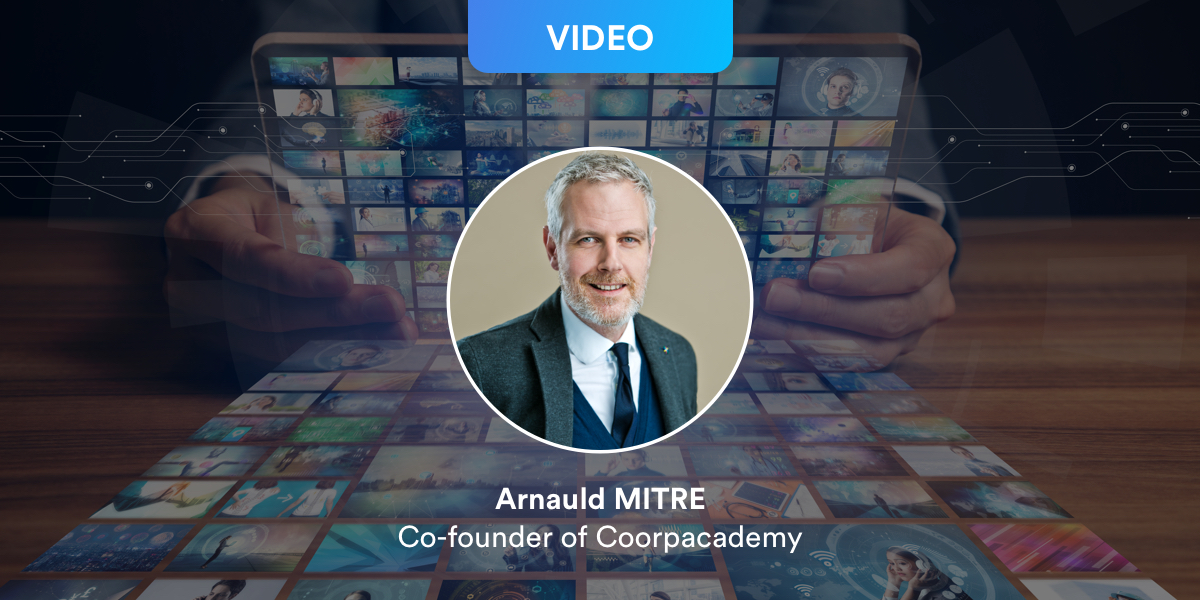
On April 23rd, Coorpacademy co-founder Arnauld Mitre was invited by Fabernovel to their MultipLX, the Learning Expedition from your desk, to talk about the key stakes in corporate digital learning.

Video is in French but you can watch it with English subtitles.

Amongst these stakes, content. One of the biggest issues in the learning and training industry – which is a content industry – is to think that 2 contents with the same name are worth the same. Thinking that I would be able to learn how to become a better manager for example, on any support, with any course called ‘How to become a better manager?’ There are no other industries where this is the case.

You wouldn’t say, for example: “I’m going to watch a detective series”. But rather: “Would I watch Columbo?” or “Would I watch Money Heist?” These are not the same profiles; one chooses a particular content.

The first battle for the learning industry is the battle of content, the one you can find nowhere else, the battle of the best content.

In 1996 Bill Gates was already saying: “Content is King.” And it is even more true in the learning industry!

What about you? Are you more Columbo or more Money Heist?

Coorpacademy trained 20,000 medical professionals and caregivers in 2 weeks during the COVID-19 outbreak


This article has been published in Les Echos, an economic French newspaper, and has been written by Déborah Loye. You can find it here in its original version.

Coorpacademy trained 20,000 medical professionals and caregivers in 2 weeks during the COVID-19 outbreak

The startup specialized in online training for large corporations launched a pro bono platform for medical professionals and caregivers. In particular, they can train in resuscitation processes.


Specialized in online training for large corporations, Coorpacademy, founded in 2013 by the former Google France Managing Director, and which raised 13 million euros, had no intent to position itself in the medical field before the coronavirus outbreak.

Training in resuscitation

Antoine Poincaré, Coorpacademy’s Director of Sales, explains: We only had a small ongoing research project with the AP-HP (Paris Hospitals) before that. The day before the confinement in France, we’ve suggested to them that we could launch a series of online training courses based on Covid-19 recommendations, for their medical staff. They answered positively right away!At this moment, the AP-HP is expecting to call for renforcements for resuscitation in other medical fields, and even in the poll of interns and medical students. The need for skills is urgent.

At Coorpacademy, 15 people are mobilized among the 45 employees, in order to launch the platform and to make it up and running. “We gathered existing videos and shot others, which we keep doing“, Antoine Poincaré indicates. The training material is very practical, and allows medical staff to act fast with resources available. “The platform looks like Netflix, with series of online training courses.

Martin Hirsch is the Managing Director of the AP-HP.

In two weeks, the Coorpacademy platform saw more than 20,000 people signing up. Less than half are nurses, 30 % are doctors, 10 % are midwives and 14 % have other specialties. For Coorpacademy, offering this service, the goal is to make it known by as many people as possible.

For now, people mainly know us thanks to word of mouth, Antoine Poincaré says. The AP-HP wrote a press release about the partnership and Martin Hirsch, its Managing Director, published a tweet praising the initiative. “We think the platform will be particularly helpful for hospitals taking in charge COVID-19 patients“, Antoine Poincaré estimates.

Déborah Loye.


If you want to read the article in its original form, in French, it’s here.

If you want to share the platform, it’s here.

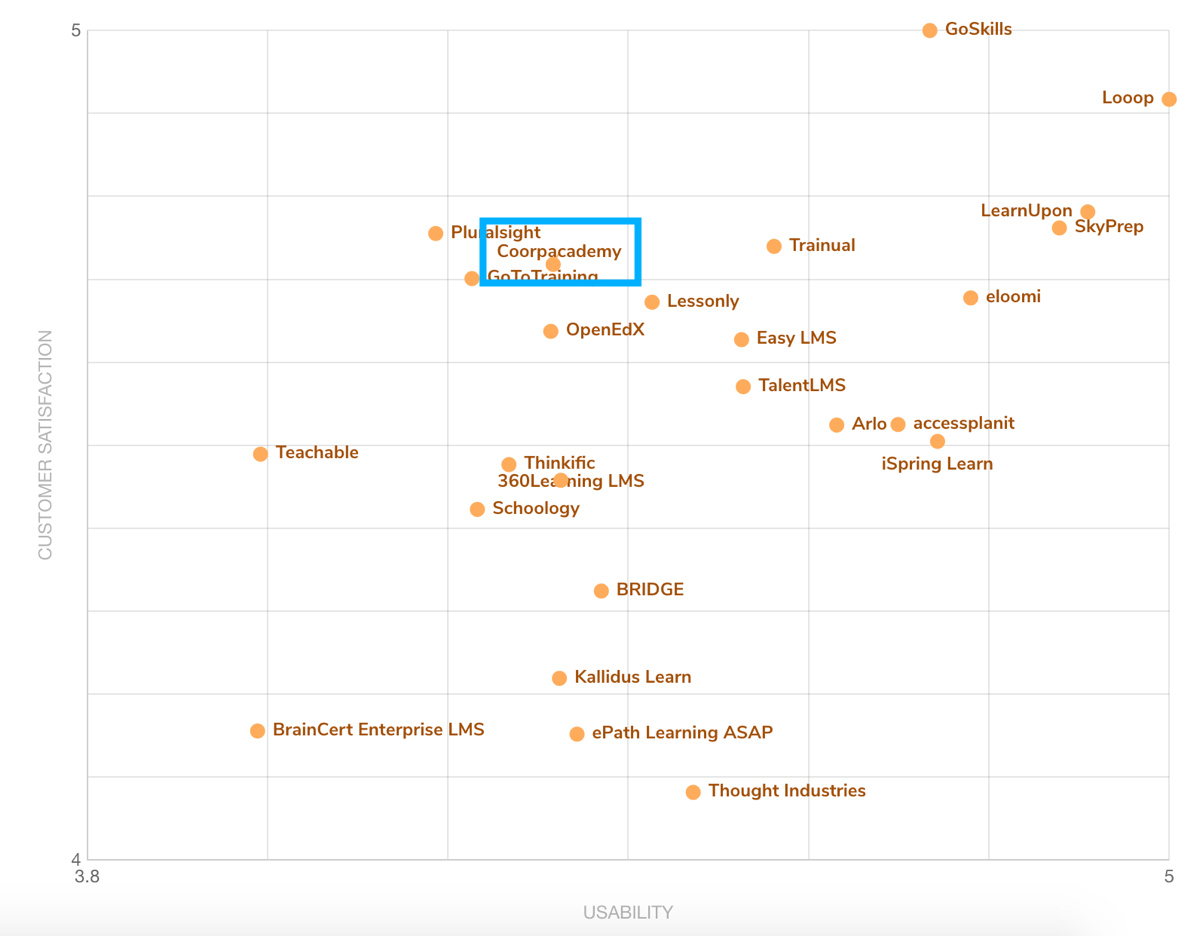
For the second time in a row, Coorpacademy has been recognized as a FrontRunner® for Learning Management by The Gartner Digital Markets Research Team!


Coorpacademy has been recognized as a FrontRunner® for Learning Management by The Gartner Digital Markets Research Team, for the second time in a row!

FrontRunners is a 100% data-driven graphic, published on Software Advice, which helps businesses easily identify the top software products in a particular category, based on verified user reviews across three websites: Capterra, Software Advice and GetApp, which operate under Gartner Digital Markets umbrella brand.

Coorpacademy recognized as a FrontRunner for the second time in a row

How does it work?

Software Advice’s FrontRunners uses reviews from real software users to highlight the top-rated Learning Management software.

To be eligible for inclusion as a FrontRunner, a product must:

  • Have at least 20 unique user reviews in the last 24 months
  • Offer the following core functionality: course tracking, course management

Products that meet these requirements and earn the top scores for Usability and Customer Satisfaction made the cut as FrontRunners.

We are proud at Coorpacademy to have been recognized by users as a top player in terms of Usability and Customer Satisfaction for the second time in a row. This result rewards the work we’re doing at Coorpacademy to offer the most user-friendly learning experience, and demonstrates that our product improvements are always centered on the learners’ overall experience.

Discover more here!


Data, Data, Data, but what for?


The Data Touch was born to address a number of missed digital analytics opportunities within organisations and was founded by Penelope Bellegarde, an established digital analytics practitioner since 2007 based in London and English & French bilingual.

Over the years, Penelope Bellegarde has worked with a wide range of organisations: in the private and public sector, big and small, as a consultant for one of the top professional firms in the world and also as a digital analytics manager for top media and travel firms.

The Data Touch launched a content partnership with Coorpacademy to co-edit digital learning courses. There are two available courses on Coorpacademy’s digital learning platforms: An impactful yet simple data methodology for businesses, and The art and science of Data visualisation.

We had the opportunity to sit down with The Data Touch’s founder, Penelope Bellegarde, who answered our questions. This interview is also available in French, just here.

Why did you found The Data Touch?


I founded The Data Touch three and a half years ago in London to address three main challenges. The first challenge is to successfully create tangible value from digital data. Indeed, a lot (too much!) data is collected in this field and it still too often translates into endless reports as opposed to real value for companies.

The second challenge is to break down the barriers that exist between data departments and senior management in companies. These two groups of employees rarely speak to each other indeed and getting both groups of people engaged in a dialogue is  a huge source of value for companies. In fact, when managers know the art of the possible with data, they will want to become more data driven! And when analysts better understand the company’s objectives, their analyses will be all the more impactful and will really start influencing!

Finally, the third challenge that I wanted to solve was to “arm” employees and individuals who do not have a technical profile with a data culture and efficient and simple methodologies to set up. In the digital world, new personalised campaigns are launched more and more frequently. It’s therefore becoming very important for companies to understand these initiatives’ return on investment. This results in an increasing demand for quantified results. Therefore more and more people who are not analysts must increase their skills in the data field. That’s why I have designed and have been delivering data training programs for both companies and for Business Schools students, i.e tomorrow’s leaders.

What are the reasons that lead you to consider data as the most important resource of the 21st century?


One of the main advantages of data is that it can provide objective answers and therefore allows consensus within companies. But the questions we ask must be source of value!

Data also makes it possible to grasp new trends and new phenomena that we would not have suspected with our brains alone … For example, machine learning techniques and in particular unsupervised learning such as clustering allows the identification of distinct groups (of customers, etc.) that we would not necessarily have suspected existed.

Data also makes it possible to anticipate and predict behavior and therefore brings a real competitive advantage to a company.

What are the criteria that make a data project successful as opposed to a “waste” of time and investment?


As we make it clear in the course, there are essential elements to keep in mind if you want to succeed in your data projects. First, let’s start by asking a good question: by the time we have an answer to the question, will it drive the company forward and will the company be able to act on the recommendations? Do not hesitate to involve several stakeholders at this stage to get to a rich and precise question. Then, depending on the questions identified, we need to look at what key data in particular we will focus on. Among all the available data, what is a real indicator versus  just “noise”? … Once the analysis is completed, it must be communicated effectively to the stakeholders who will make decisions. This is quite fine work because you have to succeed in translating sometimes complex elements into a simple language and above all into findings that are directly addressing the company’s objectives or its strategy or findings that can shape its products or influence its customers…

Until recently, everyone was talking about Big Data, however, now, it seems as if the excitement around Big Data has reduced significantly…


Yes, that’s true! It is now replaced by AI: Artificial Intelligence!

These buzzwords are often a response to a rapid “technological push” that claims to revolutionise everything. But let’s be careful here, just because the technology is advanced, it does not mean that this revolution will create value automatically by simply investing in technology. It is still necessary, as we discussed in the previous question, to focus on what is important.

Why Coorpacademy? How was the process of creating courses with Coorpacademy?


As one of the key reasons to launch The Data Touch was to empower as many people as possible with data knowledge, being able to deliver training online in an engaging way was very appealing to me. So, when I was contacted by Coorpacademy for a first online training project, I immediately said yes!

A very close collaboration followed. First, we worked together on selecting key themes and the content around these themes … Then, it was a question of writing the scripts, the quizzes and finally to produce the videos. For my part, I found this collaboration very effective and enjoyable.

Why do you think lifelong learning is crucial for the years to come and to deal with the uncertainties of the future?


I think there are many factors that can explain this phenomenon.

First of all, technological advances lead to new jobs such as data scientists for example. Although the concepts behind this type of career are not new, it’s only now that data scientists are able to make the most of the data that is available by taking advantage of the growing advances in computers’ processing powers.

Another factor related to technology is the spread of data in all departments of the company, including in departments that traditionally had never used data day-to-day. But nowadays, business leaders expect a minimum of data understanding from their stakeholders.

From a sociological point of view, I also think that we are extremely lucky to live in an era where listening to one’s professional desires has become more of the norm. Even just a few years ago, that was the exception. Now people are much less reluctant to retrain and experiment!

Finally, we have become increasingly aware of the limits posed by traditional education systems. For example, those systems have always favored technical skills over skills that are more related to emotional intelligence. And demonstrating emotional intelligence is a priceless asset in the business world. People are becoming more and more aware of it and therefore decide to train themselves in these techniques.

The need for lifelong learnings is therefore one of the major disruptions that has affected the labor market over the past several years. From now on, each individual is very likely to work in several different jobs  and this is a great opportunity! But this obviously requires regular investments in new training and also means that we need to be able to pause and reflect on our career choices on a regular basis…

Being able to train continuously is crucial because it forces us to adapt, to reinvent ourselves and therefore to remain competitive!

From a legal point of view, data collection and the way some companies have chosen to use data has been marred by scandals, in particular with regards to data privacy… Do you think that this global awareness is an opportunity or a threat to the use of data?


For my part, from an ethical point of view, I think that more transparency was necessary. Consumers have the right to better understand what data  is collected about them and for what purposes. However, data collection in many cases is a source of value for consumers. The more a company knows about your habits, the more it will be able to offer consumers more personalised products or services and save them time.

Now from an analytical point of view, I actually remain optimistic about the impact those recent data privacy laws will have on data collection. Indeed, I think that bringing more governance around data is a good thing. Today, we have access to too much data and yet, we don’t do much with it. The more limited the data, the smarter and the more creative the analytics field will become. For example, if some data is no longer available, we’ll be forced to think about what other similar data we can replace it with…

What makes you passionate about data?


Many things! But I must say that the range of skills required to succeed with data is so diverse that this field continues to fascinate and to stimulate me!

When we look at data from an outsider’s perspective, we always tend to only see the mathematical, statistical aspect of data. But data is also an art! Indeed, as we explain in the course it is absolutely critical to be able to translate quantified discoveries into a simple, tangible language that focuses on the value that these discoveries can bring to the company… Not easy !

We have to learn how to keep an open mind. We often have a tendency to want to use data to confirm a hypothesis that is close to our heart rather than letting the data speak for itself.

Finally, it is obviously useful to know a lot of useful tools for data manipulation. And, it’s actually very important to keep up with those new tools by investing in ongoing training. Some very powerful tools for data manipulation are indeed relatively young. For example, Pandas, a fundamental library to manipulate data in Python was created in 2008. Google Data Studio, Google’s data visualisation tool was launched in 2016…

How to perpetuate agility rituals remotely? The feedback example


Our content partner Numa organized a webinar on Friday 27th 2020 with Coorpacademy, as the first episode of the webinar series Learn @ Home. Claudio Vandi, Head of Learning at Numa, told us about how to perpetuate agility rituals remotely and how feedback can help to maintain the social link with your coworkers during those unprecedented times.

Learn @ Home is a webinar series launched by Coorpacademy which will give you tips to make the confinement period an efficient one.

In this article, you will find a recap of the webinar. 

Why feedback, and why using feedback remotely?

Giving feedback is not a new concept. But why are we talking about it so much nowadays? Gallup, the research institute on management and future of work which publishes studies on a regular basis, recently came up with a book called It’s the Manager, written by Jim Clifton and Jim Harter. The book contains the following:

“Leaders’ priority must be to help their managers becoming coaches: by doing regular one-to-one meetings (quick meetings, individually, weekly meetings with each and every one member of your team) and give feedback regularly.”

This is part of the manager’s toolbox – not a new way of management. There are cases where being direct is more useful, by providing guidelines or by helping. This being said, creating these regular feedback moments is becoming more and more important, especially in the new agile ways of working. Knowing how fast our businesses, our products, our services, our jobs are transforming, an annual performance review is not enough anymore. If we want to improve, to upskill in this fast-paced environment, feedback is a very efficient way to do so.

In these unprecedented times of remote working – for most people – there are a few risks. At least 3. 

  1. A feeling of looseness, of disengagement, a “I’m home” feeling. In the long term, this feeling can grow.
  2. Losing contact with your team, with your company, a feeling of isolation. As you don’t see your team or your company materially speaking, a feeling of isolation can grow. Even if you exchange with colleagues on corporate social networks, it is not as informal and as frequent as it can be in the office, around the coffee machine for example.
  3. Losing informal contacts with coworkers. We don’t see in real life people we are used to working with, and we keep our contacts to the technical aspects of the job, of what is being done, of what needs to be done. There’s a risk of losing the engaging informal conversations with colleagues. 

To limit those risks, the manager has options. 

  1. Making contact moments a ritual. If you are already doing so, it is even more important when everyone is working remotely (check-ins, weekly or even daily one-to-ones, team meetings to start or finish off the week). These don’t have to be long, they can be 10-minute long just to check if the other person’s ok. It also adds some pace to the work week and helps maintaining coworkers’ engagement.
  2. Humanizing contacts. You can introduce emotions, humor, energy in conversations. Even more than in real life, you need to overact: emotions will be mitigated through the screen, because of distance.
  3. Give feedback regularly to maintain engagement and performance. That’s what we’ll be talking about in this article.

That being said, why don’t we give more feedback?

It is extremely important, so why is it not natural to give feedback everyday, all the time, to your coworkers or managers?

Let’s dive into the book The Feedback Imperative from Anna Caroll, which indicates that there are 4 profiles of people who are biased. Those bias prevent these types of people from giving feedback regularly to their teams. 

  1. The Analytical profile: they believe in data and see feedback like an intrusion of emotions in the corporate world. We are here to work and not to talk about emotions of others, I’ve got all the data I need to manage my team and I won’t improve my management by exchanging with everyone. 
  2. The Empathetic profile: fostering and helpful, they see feedback as painful for the ones receiving them. My team are already putting a lot of efforts in their work, it will be painful for them to review what they have done wrong. They see feedback as negative feedback. 
  3. The Efficient profile: they like rapidity, are results-oriented, and see feedback as a waste of time. People won’t change, if they didn’t understand now they won’t in the future, there’s no point in wasting time in explaining to them. 
  4. The Visionary profile: inspiring, visionary, they choose to interact with their teams rather than with individuals. They’re very skilled in engaging people with impactful speeches, but it’s more natural for them to exchange ideas with their teams rather than with individuals. 

4 biased profiles not giving feedback, and 3 types of different feedback.

  1. The Positive (Recognition) feedback: “Thank you, I wanted to thank you for your work…”  With this feedback, you want to thank someone after an action or a project accomplished. You can give this feedback on the spot (right after the action) or after reflexion (which will give more impact to the fact that you have noticed the action). You can do it privately (in one-to-one) or in public (when you praise someone in front of a team to give an exemplary impact to your words, to inspire others for example). It’s the more frequent feedback, the one you should use at any given time.
  2. The Corrective (Development) feedback: “you could improve on this, you’re already doing that well but there’s room for improvement on that other thing…” You don’t give this feedback on the spot right after the action, and you should allow yourself some reflexion beforehand. Not too much time either, you don’t want to give this feedback two months after the action. You’ll also always give this feedback privately, never in public. 
  3. The Negative (Realignment) feedback: “This is not at all what I wanted, I want to understand why…” Never in public! It can be used either for a repeated error, or for a big mistake, in order to understand why the person acted in such a way but also to make this person know that it is unacceptable. This feedback is given just after the observed action but with some preparation beforehand.  

You can use one single method, easy to remember, before giving any of the feedback up above, to structure it: the COIN method.

Context – Observation – Impact – Next steps

This is an effective method to structure feedback, for the messages to get through efficiently. First, you need to remember the precise context in which the action occurred, a precise moment you’ve observed: its needs to be factual, precise. You wouldn’t say: “I had the feeling that… I think you’ve done that because…” but instead: “I’ve observed this, I share it to you, I’d like your opinion on this.” It’s also important to explain the impacts: how this precise action has had any positive or negative impact on the team, the person, the company. And it’s always very important to conclude on next steps, to go further, to correct, to improve or to insist on something that’s already going great. 

Let’s take a few examples: 

For context, would you choose: 

A – “Every time you present a project…”

B – “During last Tuesday’s presentation…”

Answer A is vague when B is precise. You need to precise context. The answer A can make a person feel attacked. It is possible to give general advice, but you need to always precise the context or to give factual examples: “Often, when you present a project, like last Tuesday for example…” 

Observation VS interpretation

A – “Your answers lacked clarity”

B – “You were stressed”

Answer B is a personal accusation, it is to be avoided. 

Answer A is an opinion, even though slightly more adapted. It isn’t factual though and could spark a debate. 

A factual and irrefutable observation would be: “At the end of the meeting, participants told me they didn’t know what we were expecting from them.”

Probably because the messages weren’t clear. You will then discuss how to improve this, because this is not an opinion. 

Examples of impacts, consequences

For a Corrective feedback (Development), it could be: “I’ve observed that people didn’t understand what we were expecting from them. You will have to organize another meeting, and you know that they take up to 2 weeks to be organized… I give you this feedback because it has an impact on the timeline of the project.”

For a Positive feedback (Recognition): “Bravo, thanks to your action, we reached the partnership agreement we were discussing for the past couple of months. This is why I congratulate you and thank you!” Even when giving positive feedback, you need to be as factual as possible. This also needs to be objective, you don’t want it to sound fake or like sterile motivation. 

Examples of next steps

For a Positive feedback (Recognition): “Would you agree to share your experience to the rest of the team ? Because I think it is exemplary and the team should get inspired from the way you handled this project.”

For a Corrective feedback (Development): “How can I help next time? Do you see ways you could improve on that matter?”

For a Negative feedback (Realignement): “How can we do for this not to happen ever again?”

Before going through the specificities of giving feedback remotely, here are 2 pieces of advice that could be useful when it comes to giving feedback. 

  1. Avoiding the sandwich (1 slice of positive feedback, 1 slice of negative feedback, 1 slide of positive feedback). Even if it sounds simpler, it drowns the message and it loses its sense and impact. 
  2. Don’t wait for people to request feedback. “87 % of Millennials consider the opportunities of personal development as important in the workplace but only 15% of them will request regular feedback” according to Gallup’s How Millennials Want to Work and Live study. A good practice is actually to solicit feedback: it is usually well perceived and puts you in the spotlight as someone wanting to improve and to upskill, open to advice and criticism. 

Now that we’ve said all this, how do we put this into practice in a remote work environment?

Everything that’s been said before about feedback is still valuable. However, there are differences due to the fact that we’re not together in the same space and that we don’t interact with each other on a daily basis. 

The first risk being to lose human contact. You won’t see how the other reacts after giving that person feedback. When you usually give feedback, you want to observe immediately after how the person reacts towards another coworker, another client, you want to see if your praising or your advice have been taken into account and if any behavior has been modified accordingly. 

It’s also harder to decipher the non-verbal communication (posture, tension…) but also to communicate non-verbal signals. By giving feedback remotely, you won’t get all these clues that would allow you to adjust your messages. 

You can also be tempted to use communication channels that sounds easier to you, but that are not necessarily the most appropriate ones. By email, for example, but was it the most appropriate communication channel for the other person? What’s practical to you might not be as useful for the other. 

Despite these risks, there also are opportunities. 

You won’t feel intimidated by the other’s presence, as you won’t share the same space. You won’t feel “locked” in a room, especially during a negative feedback that could be taken badly: doing it remotely protects you. 

You can also be creative on the communication channels to use: videoconference, call, mail, corporate social network. It’s an opportunity to be creative.

Remote Corrective feedback: some advice.

We would strongly recommend to give this feedback via videoconference, to see the other’s reaction. 

Please use as little as possible asynchronous tools, such as corporate social networks or mail, which won’t allow any interaction – unless you already have a great relationship with the coworker. Otherwise, you can privilege tools allowing you to interact. 

Third advice would be to use mails and corporate social networks for post-feedback messages. Messages which would include what came out of the feedback, the main messages but also constructive next steps. This is useful in order to anchor your speech and to remind the other person of the following steps. 

Remote Negative feedback: some advice.

This feedback must absolutely be given via synchronous tools. It is important that you speak, that the other person hears your words, your tone, that the message is perceived as paramount. 

You also need to announce, at the very beginning, that this is going to be a tough discussion. You can start by: “We are going to have an important and tough conversation, I chose to do it now rather than waiting for the confinement to be over because I think this can’t wait.” This will free you in a way and release tension while allowing the other to get ready to listen to what you are going to say. 

You also need to be very clear on the next steps for the discussion not to end in some kind of embarrassing situation that will be amplified by distance. If you give a negative feedback without any leads for after, that will create a bad atmosphere between you two and the other could be feeling left alone. 

Remote Positive feedback: some advice.

For this kind of feedback, you have a lot of possibilities in terms of communication channels you can use – according to the message. Videoconference is always good, but you can use others. 

You can use written communication to highlight a particular effort, a success. Written communication can be read and read again, for motivation purposes for example. You can do it on Teams, on Slack, on WhatsApp for example. 

Calling is also a good way to do it, in a more improvised manner: “I just saw what you did on this project and I wanted to thank you for it vocally.” Using voice gives a lot more importance to the message you want to convey – even if it is not mandatory. 

Be creative! You can also play on timings, and distance favor this. 

You can give positive feedback in the morning or in the evening when the person is feeling overwhelmed to motivate this person. You can use key moments, like at the end of a project or just before the person goes on holidays. 


If you want to learn more about agility within your organization, discover Numa’s course, Agility in action.

If you want to watch the replay of the webinar (in French), it’s here.
Coronavirus: online training courses for hospital staff dedicated to the management of patients with severe respiratory impairment related to COVID-19


The AP-HP, Assistance Publique – Hôpitaux de Paris (Public Assistance – Paris Hospitals) turned to us to develop urgently with their teams and the Université Paris-Est Créteil (UPEC), online training courses for hospital staff dedicated to the management of patients with severe respiratory impairment related to SARS-CoV-2 (COVID-19).

In the current epidemiological context and in view of the large influx of patients with severe respiratory impairment related to CoV-2 SARS (COVID-19), there is a need for accelerated training tools for the management of respiratory failure in these patients in order to make a maximum number of healthcare professionals operational.

In this context, an online training course has been created, consisting of training courses dedicated to the management of patients with severe respiratory impairment related to SARS-CoV-2 (COVID-19).

Currently, five training courses are offered:

  • ‘B.A-BA of ventilation’
  • ‘COVID-19 in resuscitation’
  • COVID-19 patients: hygiene recommendations’
  • ‘Training Medical Students’
  • ‘COVID-19 and pregnancy’


The pedagogical content of this training will evolve according to the proposals of the expert/recommendation centres and may be subject to modifications/updates.

More than 20,000 healthcare professionals have already signed up to these courses.

If you know healthcare professionals around you, do not hesitate to share these online training courses rapidly and massively. It is available on computer and mobile, open to all of obviously free of charge.

We hope these modules will be helpful to all staff facing the pandemic: thank you for your work in these unprecedented times.

http://www.formationcovid19.fr

To share massively!

Some feedback we have received on the platform:

Theory is explained and questioned. Then knowledge is assessed by questions corrected in real time. A scenario is proposed allowing a visualization of the care and a better projection of the learner in the care situation. Bravo and thank you!

Odile


Pedagogical, ergonomic, clearly one of the best strategies to transmit good practices.

Stuart


Courses are very well done, very clear and this is a great tool to learn, to reskill – especially in present circumstances where I ended up conducting ‘COVID rescuscitation’ after 21 years of surgery.

Marc

Everybody: stay at home, work remotely, we will help you!


How to be efficient remotely? Facing the global Covid-19 outbreak, most companies are making their employees work remotely. Unprecedented times, unprecedented measures. But organizations and employees are not at the same level when it comes to working remotely.

This is why we unveiled on all our learning platforms a special playlist, “Remote Working”, including all you will need to be efficient at work remotely and to be agile!

Tools to work remotely like a boss

Communicate at all times with instant messaging or videoconferences. 

  1. Slack is an instant messaging platform (text, call and video) which regroup people by channels and gather all the information you need to work. Slack can interface itself with numerous services and applications already implemented, such as Salesforce, Google Drive…
  2. Microsoft Teams is a similar platform where you can chat with your coworkers, invite them to meetings, call them or collaborate with them in a dedicated online place, wherever you are.
  3. For videoconferencing, let’s not forget Skype, Zoom and others (Google Hangouts Meet, appear.in, join.me)… Participating in meetings in video, remotely, has never been this easy!

Virtual collaboration for work in real life!

With tools such as Dropbox, Google Drive or Microsoft OneDrive, you can upload all your files online and allow instant consultation and/or modification, in real time,  to several coworkers on documents such as word documents, spreadsheets or slides.

Manage your projets remotely and plan your meetings smartly. 

  1. One of the most famous tools, Trello, will allow you to organize your projects and to prioritize tasks in an agile, fun and enriching way thanks to its boards, lists and carts.
  2. For agendas, you can use your virtual calendars such as Google Calendar. You can also associate this tool to Virtual Assistants such as Clockwise or Julie Desk which will help you plan in a seamless manner: by doing this, you will avoid confusing back and forth discussions to set up times for a meeting.

Good tools make a great worker, yes, but “men are social beings” (Aristotle).

Remote working implies using these tools efficiently for communication to be as seamless and efficient as possible. The main objective is to remain performant but also to limit the risks of bad comprehension, loneliness and induced stress. The way of managing your teams and handling your emotions are paramount, and these are skills for which anyone can learn, upskill and improve. 

The online learning playlist “Remote Working” includes courses on new agile management methods and on stress and emotions management. Every details need to be taken into account, even simple 5 minute breathing exercises to relax. 

Our team of instructional designers has aggregated for our learners the most adapted courses to face the unprecedented situation we are currently living. This aims at improving everyone’s efficiency in a very concrete way. Whether it is about personal organization, project management or the remote management of a team, discover in this new playlist:

  1. methods to structure one’s workload and manage allocated time and priorities, 
  2. online tools to collaborate and communicate as a team,
  3. new agile work techniques,
  4. but also – and this is important – simple methods to stay zen and relax, to manage one’s emotions and others’.

Try this new playlist out!

6 hours of learning content, whether you do it as complete courses – between 30 and 45 minutes – or in short microlearning learning nuggets.

Stay safe, take care of yourself and others, and happy remote working!

If you want to go further, discover these management advises on HBR.

From ‘have to learn’ to ‘want to learn’ at PwC France


Murielle Navarre, Head of Talent & Development, at PwC France, explains in this article published in The People Space how a new training resource gives employees more control and enjoyment as they upskill.

To read it in its original form, it’s here! 

As one of the major branches of the global PwC network, PwC France needs to be fluent in the evolving language of 21st century business. Whether B2B clients want to talk about digital transformation, or advances in data analytics, our teams need to be well versed in the latest terminology and ahead of upcoming trends.

That’s true for everyone in the company, not just its front line business and technology consultants. With around 5,000 people working for PwC France, that’s a lot of people to keep up to speed.

An added challenge for us: our employees spend a lot of time out in the field, on-site, on-project, in meetings or at industry networking events, so the opportunities for formal classroom-based training are limited. We also firmly believe PwC has a responsibility to practise what it preaches – which, in the context of learning and development, means keeping content, channels and formats modern and relevant so people engage with and get the most from them.

PwC has a responsibility to practise what it preaches – which, in the context of learning and development, means keeping content, channels and formats modern and relevant so people engage with and get the most from them

All-you-can-eat learning

All these factors led us to rethink the way we approach employee learning and development. Specifically, we wanted to get away from old-fashioned, top-down approach of mandatory training imposed from above. Therefore, the workplace learning we wanted to offer had to be in the form of e-learning that was smart, consumer-like and properly integrated into the flow of everyday work, so as to encourage learners to develop all their skills to their full potential and to future-proof their careers.

So clearly, we needed to move away from making training something formal and mandatory, and make it more inviting and fun. It was important to make the experience more engaging and accessible, so people would become more active in their own development, always choosing the content they want to consume to upskill themselves.

At a global level, we have launched a worldwide initiative to raise people’s digital knowledge, so that anyone in the company can talk authoritatively about everything from blockchain to machine learning. So rather than create a one-size-fits-all L&D programme we launched a Digital Fitness application, specifically designed to identify gaps in people’s knowledge which they could address at their own pace, via a menu of different resources.

Feeling that some of the proposed content was not going to engage (as it relied on team members reading PDF-based documents, for example), we decided to create a more modern, self-guided L&D experience for our employees, with richer content and learning pathways adapted to individual needs.

In essence, rather than push people through something they ‘had’ to do, we wanted to offer them something they would enjoy, which they would benefit from personally, and which was easy and convenient for them to engage with.

Evidence-based success

PwC France found its ideal partner in education technology supplier, Coorpacademy. What we liked particularly about Coorpacademy’s approach is that it’s based on real evidence about the way people learn most effectively. Plus, it allows for people learning in different ways. This really stood out for us, along with some impressive success statistics.

As stated, our people are already extremely busy, so we wanted to make the content very compelling as well as easy to digest in small chunks as and when they have time. That could be between meetings, or while travelling. Post-implementation, the good news is that all these targets are, one-by-one, all being achieved. PwC learners particularly appreciate the fact that they are asked questions before any teaching takes place, meaning they only ever get offered the lessons they need. People also feel very proud when they’re able to answer the different questions, which spurs them on.

Global search: customised L&D content on demand

The whole PwC network is looking to transform training – to make it more of a ‘Netflix’-type experience, where users can create and share a ‘playlist’, like or dislike content, and so on. We’ll embed the platform within this environment, aligning competencies with keywords so when people search they can find our content very easily.

Ultimately, all of this work is also being seen by the PwC France L&D team as the foundation of a move towards adaptive learning, in which content and teaching frameworks are customised to the individual.

That’s because we want to provide more adaptive learning based on people’s current level of knowledge. The aim is to give our employees a greater sense of responsibility and control over their own learning and development. And so far, we seem to be striking the right chord – people like the way they can understand and follow something whether they have 5 minutes to spare or 20, and can skip straight to the content that will help them, for example.

We know it’s vital that we continuously update people’s skills given the pace of change today, and the Coorpacademy learning platform helps us do that, as it’s the perfect delivery vehicle for providing engaging, tailored and easily accessible high-quality content which people can consume quickly and enjoyably, whenever and wherever they can or need to.

Murielle Navarre is Head of Talent & Development at PwC France

Read the article in The People Space! 

Coorpacademy, in 1 minute


Facing the uncertainties of the future, only one thing is certain: the need to train and to learn continuously. And with yesterday’s legacy tools it’s simply impossible to do so.

The solution? A digital learning tool suiting our everyday professional lives. With its learner-centric platform and its +1,500 course catalog, Coorpacademy is the solution to train on soft skills, the skills which will allow learners to learn tomorrow’s skills.

For a better impact, the Coorpacademy platform is constantly adapting to the way people learn thanks to its behavioral analytics and Machine Learning algorithms.

In addition to the included course catalog, Coorpacademy also allows companies to create their own tailored courses and to push them live in a few clicks on their personalized branded platforms.

What makes Coorpacademy’s learning experience different from others? A unique pedagogical method with the flipped pedagogy: it allows learners to start with the questions before accessing the course material if he/she already knows the topic.

The Battle mode and the ranking allow the learners to challenge their peers on topics.

The platform’s flexibility allows learners to start a course at the office and to complete it in the subway, and the certifications are there to validate learners’ skills.

This is why more than 100 companies chose Coorpacademy and that 800,000 learners in the world train daily on Coorpacademy with an engagement rate up to 90%. Make your company a learning organization with Coorpacademy!

Now you know.


Voir l'étude de cas